
Is a Bad Capacitor Why Your AC Quit? Signs, Costs and the Texas Heat Factor
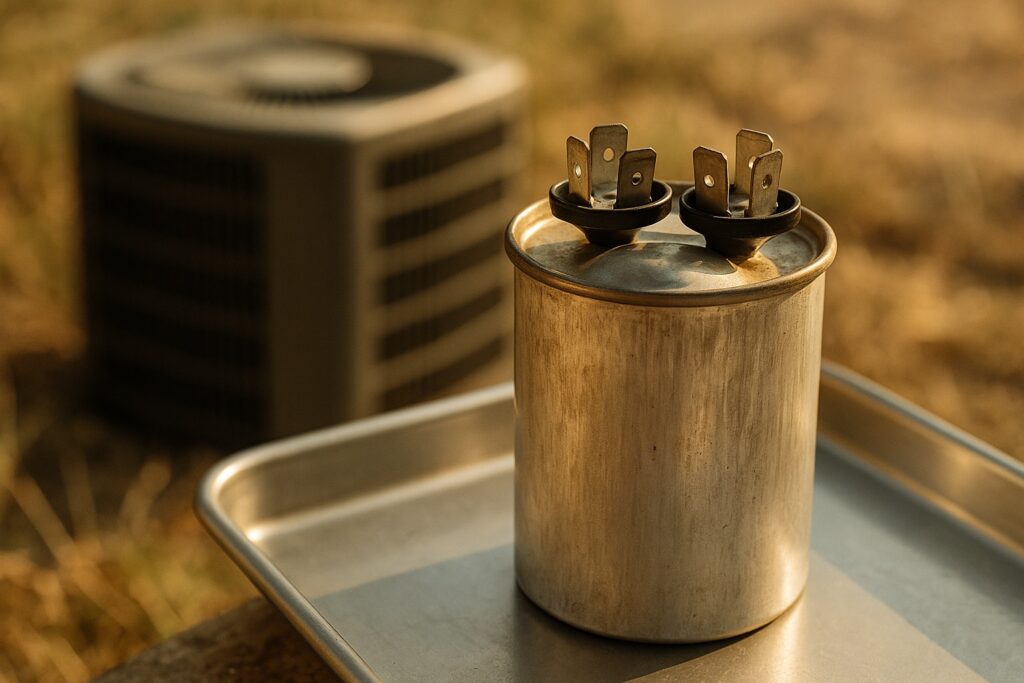
A bad AC capacitor usually shows up in one of three ways: the outdoor unit hums but the fan won’t spin, the system struggles to start, or the vents blow warm air. Replacing one typically costs about $100 to $350 with parts and labor, according to Bryant, and the part itself is the cheap piece of that bill.
The longer answer matters more in Central Texas, where long, hot cooling seasons are hard on the small electrical parts in your outdoor unit. Here’s how to spot a failing capacitor, what moves the replacement price and when it’s a clue to something bigger.
What an AC capacitor does in your air conditioner
An AC capacitor is a small, can-shaped electrical part in the outdoor unit. It stores a charge and releases it to start the compressor and the condenser fan motor, then helps keep both motors turning. When the capacitor weakens, those motors can’t get going, so the air conditioner hums, stalls or quits.
Your home’s power runs the motors, but they need an extra push to get moving from a dead stop. A heat pump works the same way, with the same outdoor compressor and fan.
Each capacitor carries a microfarad (µF) rating and a voltage rating on its label. Cornell Dubilier, a major capacitor maker, builds its standard motor run capacitors to within plus or minus 10 percent of the label rating. An HVAC technician tests the part against that label, and a reading outside the window means it’s done.
Start, run and dual run capacitors
Most home systems use a run capacitor, which stays in the circuit while the motor runs. Many outdoor units use a dual run capacitor, which is two capacitors in one can: one side for the compressor, one for the fan. A start capacitor gives a short, strong kick to a hard-starting compressor, then drops out once the motor is up to speed.
Signs of a bad AC capacitor
The most common signs of a bad AC capacitor are a humming outdoor unit with a fan that won’t spin, a system that struggles or fails to start, warm air from the vents and short cycling. Sometimes the capacitor itself is swollen on top or leaking oil, which a technician can spot during an inspection.
- Humming with no fan. The motor has power but not the push it needs to start.
- Slow or failed starts. The system clicks, hesitates or doesn’t come on at all.
- Warm air inside. The indoor blower runs, but the compressor outside never kicks on.
- Short cycling. The unit shuts off and restarts before the house cools down.
- A tripped breaker. A struggling motor can pull extra current and trip the AC breaker.
- A bulging or leaking can. A tech checks this with the power off and the panel open.
A higher electric bill can be a clue too. Carrier notes that a weak capacitor makes the motors work harder and draw more amperage.
AC capacitor replacement cost and what moves the price
AC capacitor replacement typically costs about $100 to $350 including parts and labor, according to Bryant, while Carrier puts most jobs between $100 and $400. The part is inexpensive, so most of the cost covers the service call, diagnosis, a correctly rated part and testing the AC system afterward.
Those are national ranges, not a quote. A few things move the number:
- Capacitor type and rating. Single run, dual run and start capacitors are different parts, and the new capacitor has to match the original rating.
- Diagnosis. Confirming the real failure takes testing time.
- Access and labor rates. Bryant lists location, local labor rates and how easy the unit is to reach.
- Other worn parts. A failing fan motor or contactor adds parts and labor.
- Warranty. Bryant notes your equipment’s warranty terms can change what you pay.
A good AC repair visit doesn’t stop at swapping the part. The tech should test the new capacitor, confirm both motors start cleanly and check why the old one failed. That last step keeps you from paying for the same repair next summer.
Why Central Texas heat wears out AC capacitors
AC capacitors wear out faster in Central Texas because heat breaks them down, and condensers here work through long, hot summers. Austin’s Camp Mabry weather station averages 28.7 days a year at 100°F or hotter and 122.8 days at 90°F or hotter, based on NOAA’s 1991 to 2020 climate normals.
The trend isn’t helping. The National Weather Service counted 11 more 100-degree days a year at Camp Mabry when the normals moved from the 1981 to 2010 period to 1991 to 2020.
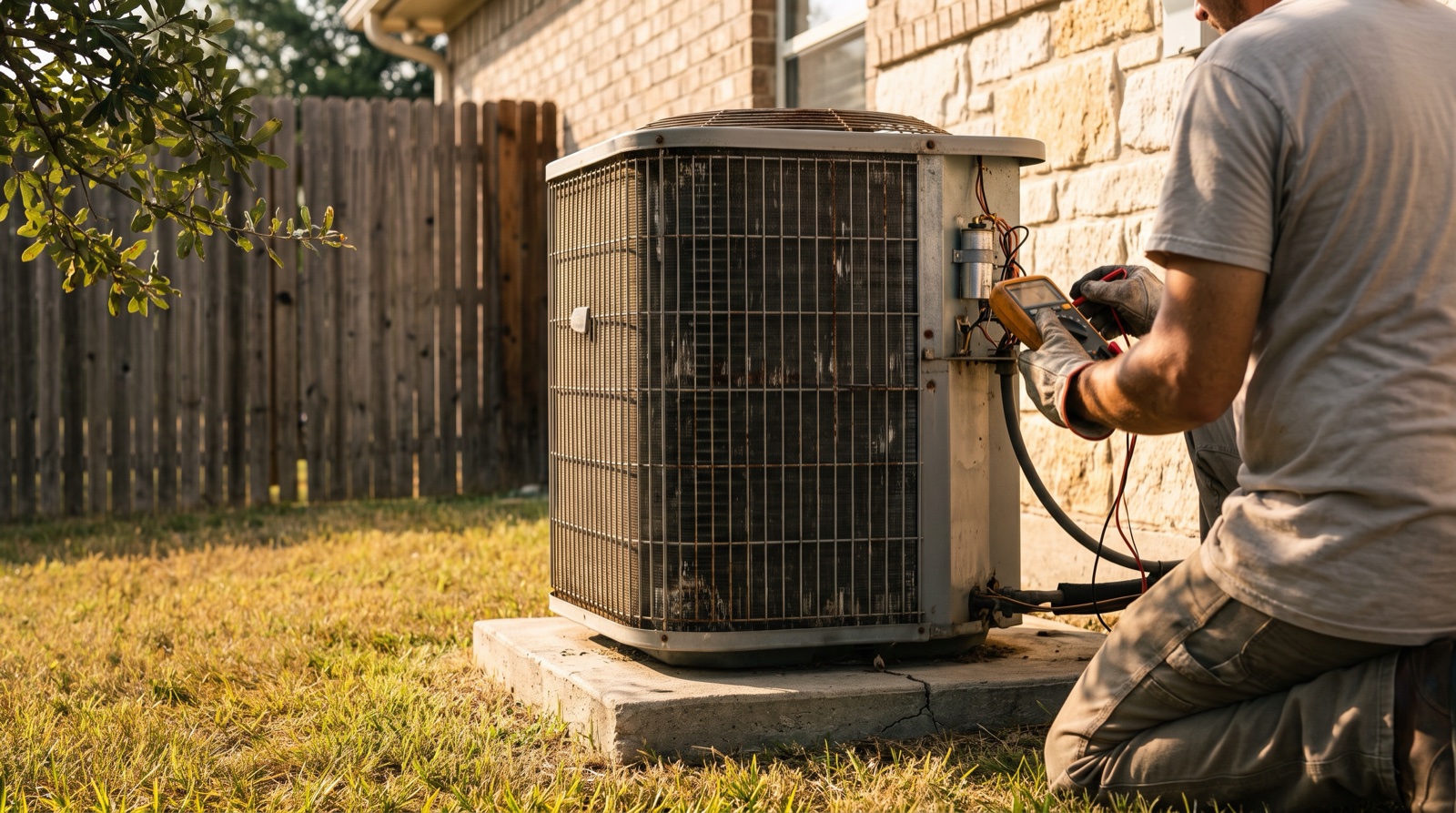
Capacitor makers rate life at a set temperature. Cornell Dubilier rates its standard motor run capacitors for 60,000 hours with a 94% survival rate at rated conditions, with a standard upper limit of 70°C, about 158°F. A capacitor in a sunbaked condenser cabinet spends more time near that hot end than it would in a milder climate, and Bryant names heat exposure as a main cause of failure.
Power quality matters too. Bryant notes that power surges and lightning can damage a capacitor, and Central Texas storm season brings both. With 83% of Texas homes on central air (EIA, 2020), this small part gets a lot of summer work.
Carrier says most capacitors last 10 to 20 years but warns that extreme temperatures can shorten that. In Hays County heat, it’s smart to test the capacitor at every spring tune-up instead of waiting for it to quit.
Is it okay to run your AC unit with a bad capacitor?
No, running an AC unit with a bad capacitor isn’t a good idea. Carrier warns that a failing capacitor forces the compressor and fan motors to work harder than intended and can permanently damage them. If the outdoor unit hums without the fan turning, switch the system off at the thermostat and call for service.
Carrier’s advice is blunt: replacing the capacitor now costs less than replacing the compressor later.
What you can safely check before calling an HVAC tech
- Thermostat. Make sure it’s set to Cool, the set point is below room temperature and the batteries aren’t dead.
- Breaker. If the AC breaker tripped, reset it once. If it trips again, leave it off.
- Air filter. A clogged filter makes the whole system work harder. Swap it if it’s dirty.
- Outdoor unit, by eye only. Check that nothing blocks the fan and listen for a hum. Keep your hands out.
Stop there. Don’t open the electrical panel on the condenser. Bryant and Carrier both warn that capacitors can hold a dangerous charge even after the power is off. In Texas, contractors who repair or maintain air conditioning systems need a TDLR license. Cool Kings holds license TACLB00074401E.
When a failed capacitor points to a bigger problem
A failed capacitor sometimes points to a bigger problem, especially when it’s the second or third one in a few years. A weak fan motor, loose wiring, a worn contactor or voltage trouble can all overwork a capacitor. A new part will fail again unless the tech finds and fixes that cause.
Bryant says a technician should check whether another part, such as the fan motor, caused the capacitor to fail. It’s also why the ENERGY STAR maintenance checklist includes tightening electrical connections and measuring voltage and current on motors. Faulty connections, it notes, can shorten the life of major components.
If the compressor or fan motor is the real issue, that’s AC condenser repair rather than a quick part swap. The simplest way to stay ahead of it is annual HVAC maintenance in the spring, before the first 100-degree week. Carrier notes a tune-up lets a tech catch a capacitor drifting out of range before it fails.
Capacitor questions we hear in Buda and Kyle
Is it worth replacing the capacitor on an AC unit?
Usually, yes. A capacitor is one of the less expensive air conditioner repairs, and Bryant puts a typical job at $100 to $350 installed. The exception is a system with a deeper problem, like a failing compressor or fan motor, or an older unit near the end of its life.
How long do AC capacitors last in Texas heat?
Carrier says most AC capacitors last 10 to 20 years, but heat exposure can shorten that. Austin’s Camp Mabry station averages 122.8 days a year at 90°F or hotter. Have the capacitor tested at each spring tune-up so a weak one gets replaced on your schedule, not on the hottest afternoon of July.
Can I replace an AC capacitor myself?
We don’t recommend it. Capacitors can hold a dangerous charge even after the power is shut off, and both Bryant and Carrier advise leaving the job to a trained technician. The new part also has to match the unit’s ratings, and a tech should confirm the capacitor was the real cause.
How long does a capacitor replacement take?
The swap itself is quick. Bryant says a trained technician can usually replace an AC capacitor in 30 to 60 minutes, including testing and restarting the system. Plan on more time if the failure needs diagnosing first or the tech finds a second problem, such as a worn contactor.
Why does the cost to replace a capacitor vary between quotes?
The part is only a small slice of the bill. The service call, diagnostic time, the capacitor type, how easy the unit is to reach and local labor rates all move the total. Ask whether a quote includes testing the system and checking why the old capacitor failed, so you compare like with like.
If your outdoor unit is humming, your vents are blowing warm or your system won’t start, call us at (512) 318-7212 or request service online. Cool Kings is a father-son team, Terry and Corey Lutrick, working out of Buda since 2015, and we offer same-day service during business hours. We’ll find out whether it’s the capacitor or something bigger, give you an honest answer on cost and get your AC running again.
Get a Quote
From Our Blog