
Plum Creek, 6 Creeks and Older Kyle Homes: Why AC Problems Differ by Neighborhood
When an AC is not cooling in Kyle, the cause is usually a failed part at the outdoor unit, airflow choked by a dirty filter or coil, a refrigerant leak or ducts losing cold air into the attic. Which one is likeliest depends a lot on when your house was built, because the build year sets the system’s age, refrigerant and duct standards.
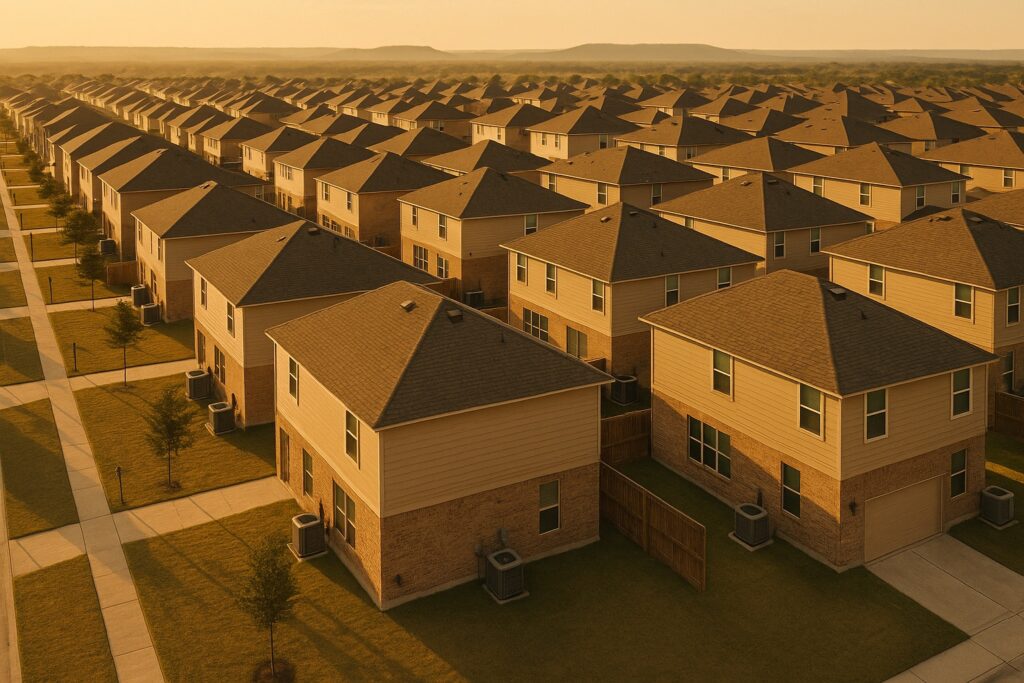
That matters in Kyle, where the median home was built in 2010 and a historic downtown sits next to subdivisions still under construction.
Why is my AC not cooling in Kyle, TX?
An AC that runs but doesn’t cool in Kyle, TX, usually has one of four problems: a failed capacitor or contactor at the condenser, a clogged filter or dirty coil, low refrigerant from a leak, or leaky ducts dumping cold air into the attic. Your home’s build year helps narrow down which one is likeliest.
The last two lean on the house itself. An original air conditioner in a 2005 house has had two decades of Central Texas summers to develop a slow leak. A system in a 2023 house is young, so when it can’t keep up, the cause is more often the installation than plain wear. Our AC repair in Kyle page explains how we diagnose a service call.
How old Kyle’s homes really are
Kyle’s homes are young. U.S. Census Bureau estimates for 2020 to 2024 count about 21,200 housing units in the city, and 87 percent were built in 2000 or later. Roughly 38 percent went up in the 2000s, 39 percent in the 2010s and 10 percent since 2020.
Only about one in eight homes predates 2000, and the City of Kyle’s long-range plan calls downtown the oldest part of the city. Plum Creek’s development agreement with the city is dated April 15, 1997, according to a City of Kyle record, and developer Benchmark now lists it at 2,200 acres with more than 10,500 homes. On the newer end, the city authorized the improvement district behind 6 Creeks in 2017 and was still adding phases in its 2026 plan.
For Steeplechase, Hometown Kyle, Waterleaf or anywhere else, look up your own year built on your appraisal district record or closing papers. The data plate on the outdoor AC unit lists its refrigerant.
| Year built | Share of Kyle homes | Likely original refrigerant | What to watch for now |
|---|---|---|---|
| Before 2000 | About 13% | R-22, if it’s still there | Older ductwork, mismatched replacement parts |
| 2000 to 2009 | About 38% | R-22 or R-410A | Original systems past 15 years, slow leaks |
| 2010 to 2019 | About 39% | R-410A | Capacitors, fan motors, sizing, duct leaks |
| 2020 or later | About 10% | R-410A or R-454B | Installation and refrigerant charge |
Older Kyle homes: R-22 refrigerant and pre-code ductwork
In older Kyle homes, an AC that won’t cool is often an aging system or ductwork built before Texas had a statewide energy code. Under the EPA phaseout, R-22 made after 2009 could only go into equipment manufactured before January 1, 2010, so any R-22 system still running today is at least 16 years old.
Many pre-2000 houses are on their second or third system, which can mean a newer condenser paired with an older evaporator coil it was never matched to. The ducts are the bigger question. Texas had no mandatory statewide energy code for homes until September 2001, when the 2000 IECC took effect (Texas SECO). After decades of hot attic summers, tape lets go, flex duct sags and joints pull apart. The giveaway: rooms at the far end of the house never catch up.
2000s and 2010s subdivisions: original air conditioners at 10 to 15 years
About three out of four Kyle homes were built between 2000 and 2019, so many Kyle air conditioners are original systems past the 10 year mark or their first replacements. ENERGY STAR advises having any heating and cooling system more than 10 years old, or one that isn’t keeping the house comfortable, evaluated by an HVAC contractor.
Outdoor parts usually go first. A humming condenser with a still fan is one of the signs of a bad AC capacitor, and contactors, fan motors and slow coil leaks follow as the years add up.
This is also when installation shows. ENERGY STAR says improper installation can cut efficiency by up to 30 percent and shorten equipment life. The Department of Energy warns that rules of thumb too often produce oversized systems, and that sizing should come from a load calculation such as ACCA’s Manual J. An oversized AC system runs in short bursts that never reach peak efficiency, which ENERGY STAR puts at about 10 minutes in, and pulls less moisture out. The house hits the setting but still feels sticky.
Warm air at some vents: attic air handlers and leaky ducts
Leaky ducts are an easy cause to miss when an AC is blowing warm air at some vents and cool air at others. ENERGY STAR estimates a typical house loses about 20 to 30 percent of the air moving through its ducts to leaks, holes and poor connections, and it lists ducts in the attic as a warning sign.
With the air handler and ducts in the attic, as in many Central Texas homes, every leak dumps cooled air into the hottest space in the house. The ENERGY STAR duct sealing guide adds other clues: high summer bills, hard-to-cool rooms and kinked flexible ducts.
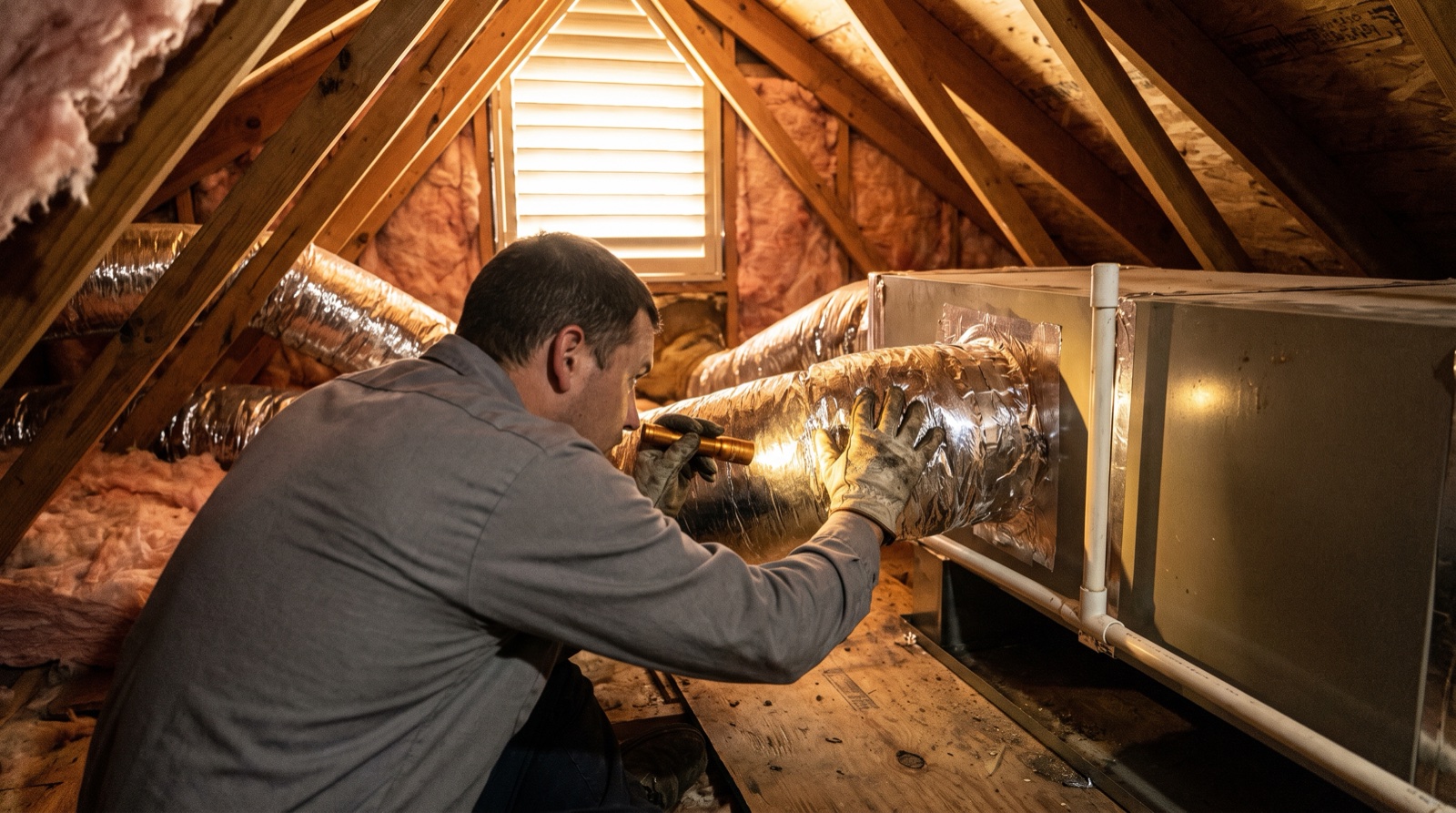
Since September 1, 2016, Texas’s statewide minimum for new homes has been the energy chapter of the 2015 International Residential Code, which requires ducts to be pressure tested and caps leakage at 4 cubic feet per minute per 100 square feet of floor area (DOE Building Energy Codes Program). A home permitted before then wasn’t held to that number. ENERGY STAR says sealing and insulating ducts can improve efficiency by as much as 20 percent, starting with the attic.
The newest homes: refrigerant changes and install problems
In Kyle homes built since 2020, an AC that won’t cool is less likely to be worn out and more likely to have an installation, refrigerant charge, drain or thermostat setup problem. The refrigerant depends on when the equipment was made: R-410A for most systems built before 2025, and lower global warming potential refrigerants such as R-454B after that.
The EPA set a global warming potential limit of 700 for new home air conditioning systems starting January 1, 2025. R-410A, at 2,088, doesn’t meet it. YORK, the brand we install as a factory authorized dealer, chose R-454B, rated 466. A May 2026 EPA rule lets systems built from pre-2025 components keep going in until that stock runs out, so a house built in 2025 could have either.
On a two or three year old system, ask for the charge, airflow, drain and thermostat setup to be checked. Check your warranty paperwork before paying for repair parts, since young equipment may still be covered.
What Kyle homeowners can check before an AC repair call
Kyle homeowners can safely check the thermostat, the air filter, the breakers and the space around the condenser, and read the data plate for the refrigerant type. If those all look fine, stop there. Electrical panels, refrigerant lines and capacitors are jobs for a licensed HVAC technician.
- Thermostat. Cool mode, set below room temperature, fresh batteries.
- Air filter. If light barely gets through it, replace it.
- Breakers. Reset a tripped AC breaker once. If it trips again, leave it off.
- Condenser, by eye. The fan should spin, with nothing crowding the coil.
- Ice. Frost on the copper line or evaporator coil means turn the system off and call.
Don’t open the condenser’s electrical panel. In Texas, contractors who repair or maintain air conditioning need a TDLR license, and Cool Kings holds TACLB00074401E. These issues are easier to catch on a planned maintenance visit than on a hot afternoon, the idea behind our fall HVAC tune-up checklist.
Cooling questions we hear from Kyle homeowners
How do I fix my AC running but not cooling?
Check the thermostat setting, the air filter and the breakers, and make sure the condenser fan is spinning. If the outdoor unit is silent or humming, or you see ice on the copper lines, turn the system off and call a licensed technician. Those point to an electrical, airflow or refrigerant problem.
Why is my AC blowing air but not getting colder?
The indoor blower is running, but the system isn’t removing heat. Typical reasons are a compressor that won’t start because of a failed capacitor or contactor, a dirty outdoor coil, low refrigerant or a frozen evaporator coil. If only some rooms stay warm, leaky attic ducts are a likely suspect.
How do I reset my AC if it’s not cooling?
Turn the system off at the thermostat, then switch off the AC breaker and the outdoor disconnect. Wait about five minutes, restore power and set the thermostat back to Cool. If a breaker trips again, leave it off and call for service, because repeated trips point to an electrical fault.
How long should the original AC in a newer Kyle home last?
There’s no fixed number. ENERGY STAR suggests having a system evaluated once it’s more than 10 years old or stops keeping the house comfortable. With the median Kyle home built in 2010, many original systems are at or past that point. Installation quality, sizing and yearly maintenance all affect how long one lasts.
Do I have to replace my R-410A system because of the refrigerant change?
No. EPA’s 2025 limit governs new equipment being made and installed, not systems already in your home. YORK expects R-410A to stay available for servicing existing equipment, though no end date has been set. Base a repair or replace decision on the system’s age, condition and repair history.
If your AC isn’t keeping up, call us at (512) 318-7212 or request service online. Cool Kings is a father-son team, Terry and Corey Lutrick, working out of Buda since 2015, with same-day service during business hours. Wherever you are in town, we’ll find the real cause, give you an honest answer on cost and help homes all over Kyle stay cool.
Get a Quote
From Our Blog