
Emergency Heat, Aux Heat and Defrost: Running a Heat Pump Through a Texas Freeze
Should you turn on emergency heat during an ice storm? Usually, no. Leave the thermostat on regular Heat and let the system bring on auxiliary heat by itself, and switch to emergency heat only if the outdoor unit has stopped working, is frozen solid or an HVAC technician tells you to. It’s a fallback for a broken heat pump, not a cold weather setting.
Central Texas rarely freezes, so the EM heat button gets pressed in a panic. In February 2021, Austin’s Camp Mabry station hit a record low of 7°F. Here’s what each mode does and how to set your thermostat for the next freeze.
Aux heat vs emergency heat vs defrost mode
Aux heat, emergency heat and defrost mode are three different things. Auxiliary heat is extra heat the system turns on automatically to help the heat pump. Emergency heat is a manual setting that shuts the outdoor unit off and runs only the backup heating source. Defrost mode is the heat pump clearing frost from its own outdoor coil.
For most homes with a heat pump heating system, Lennox says, that backup is electric resistance heat strips in the indoor air handler.
| Mode | Who turns it on | What runs | When it’s normal |
|---|---|---|---|
| Heat | You, as the everyday winter setting | The heat pump, with extra heat added as needed | All winter |
| Auxiliary heat | The system, automatically | Heat pump plus heat strips | Cold mornings, big set point jumps, defrost |
| Emergency heat | You, manually | Heat strips only, outdoor unit off | Heat pump broken, iced solid or a tech says so |
| Defrost mode | The heat pump, automatically | Reverses briefly to warm the outdoor coil | Freezing, damp weather, a few minutes at a time |
Trane says aux heat runs when demand is high or below a lockout, an outside temperature where the system skips compressor heat. An HVAC technician sets those lockout rules, not the homeowner.
Should you turn on emergency heat during an ice storm?
No, not just because there’s an ice storm. On regular Heat, a working heat pump brings on auxiliary heat when it needs help. Switch to emergency heat only when the outdoor unit has quit, is frozen solid or damaged by ice or debris, or your HVAC technician asks you to. Lennox lists those same three situations.
Central Texas ice storms usually mean freezing rain. During Winter Storm Uri, the National Weather Service reported 0.25 to 0.50 inches of freezing rain across the Austin metro on February 11. A glaze on the cabinet is one thing. A fan iced in place is another, and that’s when the emergency heat setting makes sense until service arrives. Otherwise it’s the most power hungry heat you own, the opposite of what ERCOT needs during a conservation call.
What emergency heat costs compared with your heat pump
Emergency heat costs more because resistance strips make heat instead of moving it. A heat pump owner guide published on a U.S. Department of Energy site says an air source heat pump typically has a coefficient of performance (COP) above 3, while electric resistance has a COP of 1. That’s roughly three times the electricity for the same warmth.
The efficiency gap narrows in hard cold but doesn’t close: the same guide says a heat pump can hold a COP above 1.75 at 5°F. Federal energy managers advise keeping resistance heat to a minimum.
Your bill depends on your electricity rate, your home’s size and insulation and how long the strips run. A few hours during a repair is fine. A whole freeze week on EM heat is a different bill, and Lennox adds that long stretches can hide a heat pump problem.
What’s normal for a heat pump in freezing weather
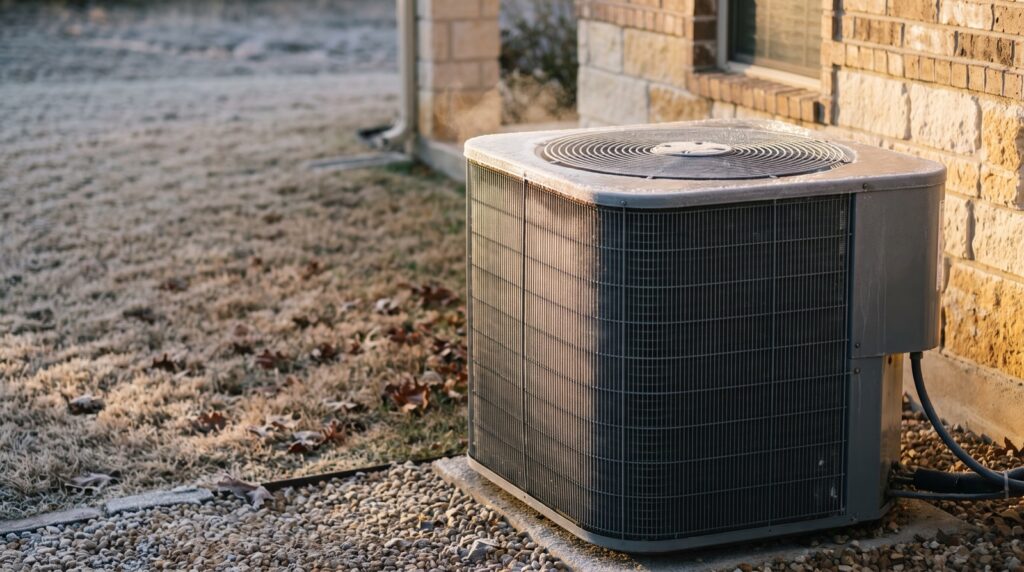
In freezing weather, it’s normal for a heat pump to collect light frost, pause for defrost, send steam off the outdoor unit and show aux heat for short stretches. It’s not normal for the outdoor unit to stay coated in solid ice, sit stuck in defrost or show aux heat on the thermostat all the time.
The heat pump owner guide on the DOE site explains defrost simply. When the outdoor coil drops below 32°F, moisture freezes on it. The system switches to cooling so warm refrigerant melts the frost, the outdoor fan may stop and auxiliary heat may come on to keep the house warm. Defrost typically takes 5 to 15 minutes. The cloud rising off the unit is steam, not smoke.
Ice on the outdoor unit
Light frost that clears on its own is normal. Ice that keeps building, or a unit stuck in defrost, needs a technician.
Freeze week thermostat settings for Central Texas
For a Central Texas freeze, set the thermostat to Heat, pick one steady temperature and leave it there. Big setbacks can trigger the heat strips during recovery, and the emergency heat mode should stay off unless the outdoor unit stops working. When ERCOT asks Texans to conserve, lower the set point a degree or two if it’s safe.
The National Weather Service called Winter Storm Uri an eight day period of winter weather across South Central Texas, February 10 to 18, 2021, with temperatures in the single digits and teens. As demand for electric heating climbed, ERCOT’s load shed orders reached 20,000 MW on February 15, according to a University of Texas at Austin review. About 19% of Texas homes heat with a central heat pump (EIA, 2020). On February 14, ERCOT asked Texans to turn thermostats down to 68 degrees and skip large appliances.
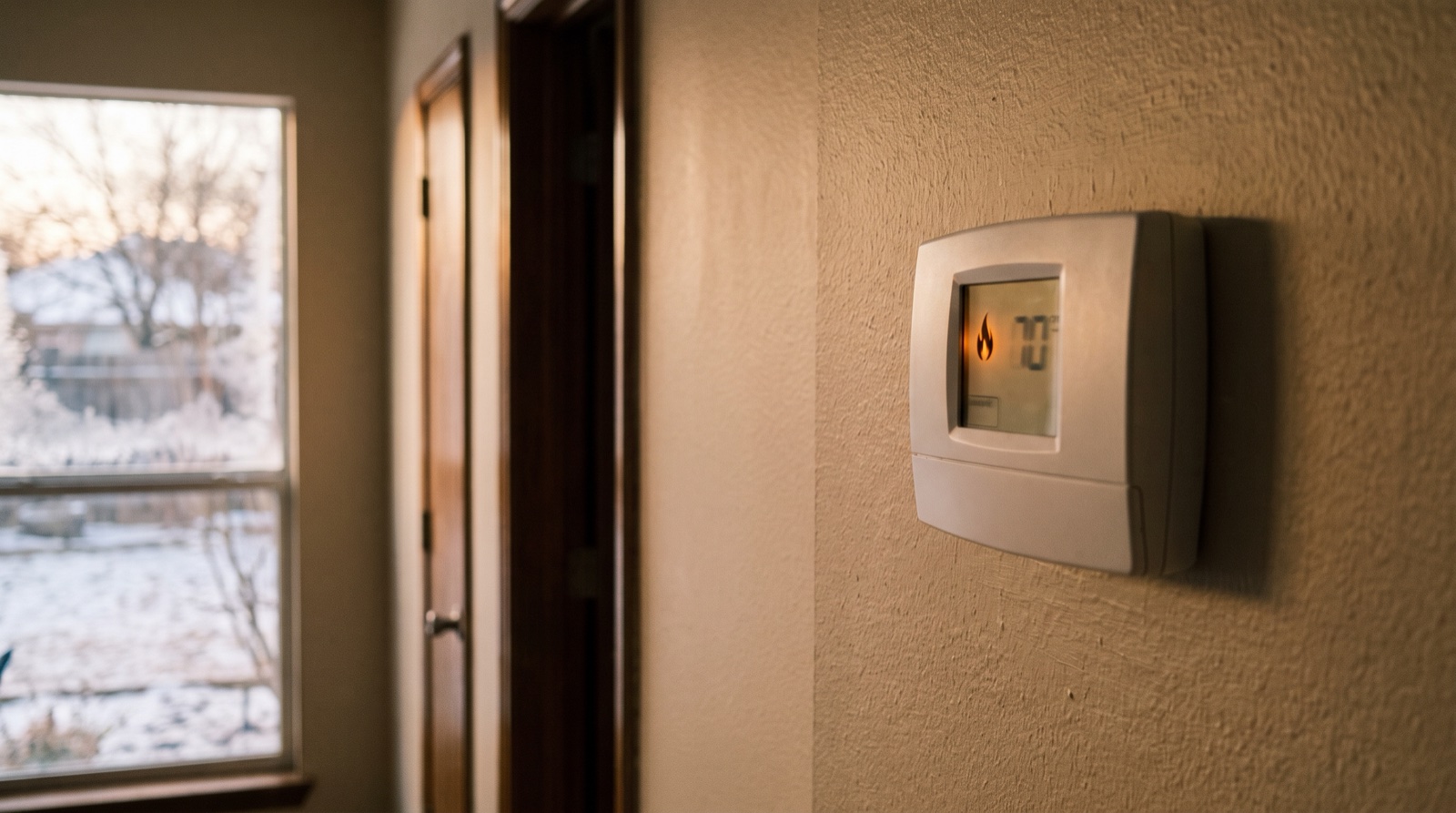
- Mode: Heat. Not Auto, which can swing between heating and cooling, and not EM heat.
- One steady set point. The DOE guide says to avoid changes of 3°F or more at once.
- No deep overnight setback. DOE’s Energy Saver Guide says not to set back a heat pump manually if it brings on electric resistance heat.
- Conserve safely. When ERCOT calls, aim for 68 degrees or a bit lower. Keep people and pipes warm first.
Thermostat problems that send a heat pump to backup heat
Thermostat problems can make a working heat pump lean on its heat strips. Common culprits are a thermostat set up for a regular AC, the wrong reversing valve setting, miswired aux terminals and lockout settings that bring the strips on too early.
In Sensi’s setup guide, the installer tells the thermostat whether the outdoor equipment is an AC or a heat pump and how many stages it has, then sets the reversing valve to O or B. Set it backward and the system cools when it should heat, which looks like a dead heat pump in a freeze. Federal guidance also favors heat pump thermostats that ramp up slowly so the strips stay off.
A thermostat repair visit checks the wiring, staging, aux and emergency heat terminals and lockout temperatures, then confirms the heat pump carries the load before the strips join in. Cool Kings installs Sensi and Honeywell smart thermostats and sets either one up for a heat pump. If the thermostat checks out and the HVAC system still won’t heat, that’s heating repair. A fall tune-up is the time to catch it early.
What you can safely check yourself
Make sure the thermostat in your home says Heat, not EM, and the screen isn’t blank. Swap a clogged air filter. Reset a tripped heat pump or air handler breaker once, and leave it off if it trips again. Gently clear debris around the outdoor unit, but Lennox says never use sharp tools or force on ice.
Stop there. Don’t chip ice off the coil, open service panels or move thermostat wires. The air handler holds high voltage strips, and Texas HVAC contractors need a TDLR license. Cool Kings holds license TACLB00074401E.
Heat pump questions we hear in Buda and Kyle
At what temperature does a heat pump go into emergency heat?
There’s no single temperature. Emergency heat is usually a manual setting, while auxiliary heat comes on automatically. Lennox notes some thermostats can switch to emergency heat on their own, and Trane says lockout temperatures are configured by an HVAC technician. If emergency heat shows up and you didn’t select it, have the setup checked.
What is the 20 degree rule for heat pumps?
It’s a rule of thumb, not a DOE or manufacturer standard. You’ll hear it two ways: keep the set point within about 20 degrees of the outside temperature, or expect vent air about 20 degrees warmer than room air. Neither fits a Texas freeze well. Pick a steady, comfortable set point and let auxiliary heat help.
Can I run emergency heat all night?
Yes, using emergency heat overnight is fine if your heat pump is down and you’re waiting on a repair. Lennox says occasional use during a repair or extreme cold snap won’t harm the system. Expect a higher bill, since resistance heat has a COP of 1 versus above 3 for a typical heat pump. Switch back to regular Heat once it’s fixed. If you’re weighing your next system, we compare heat pumps and gas furnaces for Central Texas.
Why is my heat pump blowing cool air in heat mode?
A short stretch during defrost is normal, and the DOE guide says defrost typically lasts 5 to 15 minutes. If the air stays cool, confirm the thermostat is on Heat. Sensi notes a wrong O or B reversing valve setting makes a heat pump cool in Heat mode, so a newly installed thermostat is a prime suspect.
Should I cover my heat pump during a freeze?
No. The heat pump owner guide on the DOE site says to avoid covering an outdoor unit in winter, because it needs airflow to pull heat from the outside air. Keep it clear of snow, ice and debris, and make sure roof runoff isn’t dripping onto it. If it’s iced over and won’t clear, call for service.
If your heat pump is stuck on aux, iced over or blowing cool, call us at (512) 318-7212 or request service online. Cool Kings is a father-son team, Terry and Corey Lutrick, working out of Buda since 2015, and we offer same-day service during business hours. We’ll check your thermostat setup and the heat pump behind it before the next freeze.
Get a Quote
From Our Blog