
Older Buda Homes vs. New Subdivisions: What Each HVAC System Needs Before Winter
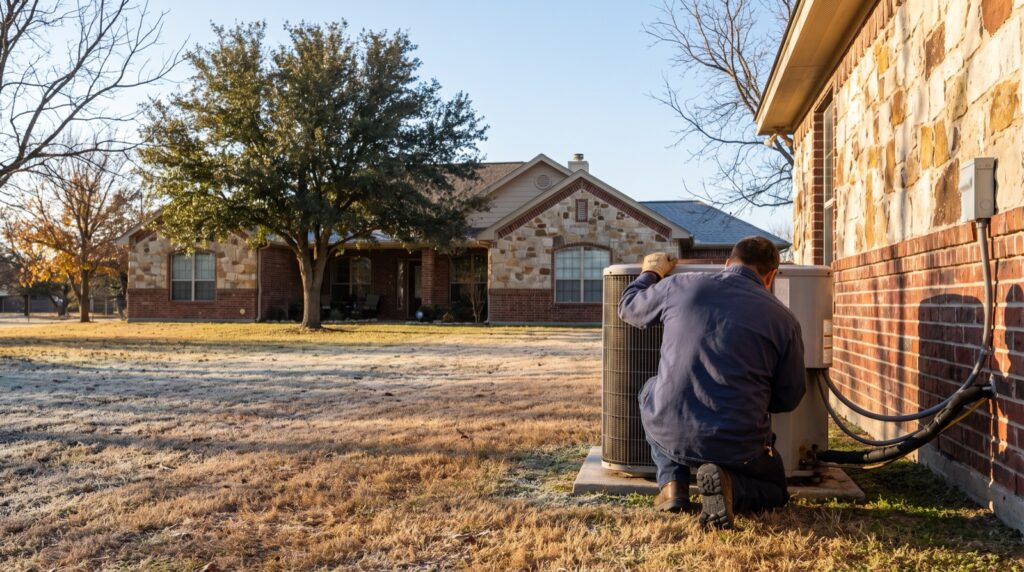
Getting a Buda home ready for winter comes down to two questions: what kind of heating system you have, and where your house is weakest when the temperature drops. A bungalow near downtown and a newer subdivision home usually run into problems in different places.
If you need heating and AC service in Buda, TX, call a TDLR-licensed HVAC contractor based close by, so a tech can reach you the same day during business hours. Cool Kings Heating & Air has been based in Buda since 2015. Here’s the winter prep we’d suggest, sorted by home age.
How Buda’s housing mix changes winter HVAC prep
Buda’s housing mix changes winter HVAC prep because the city has two very different housing stocks. Homes in and around the historic downtown can be a century old, while much of Buda’s housing went up as the population boomed after 2000. Older homes and newer homes tend to struggle in different places when a freeze hits.
The Texas State Historical Association’s history of Buda shows how fast it grew: 2,204 residents in 2000 and 15,108 in 2020. That’s nearly seven times as many people in 20 years, so much of Buda’s housing is newer construction sitting next to an older core near downtown.
The Downtown Buda Historic District, listed on the National Register in 2003, covers Early Commercial and Craftsman buildings from periods running 1875 to 1949 (Texas Historical Commission). The City of Buda’s neighborhood list includes subdivisions such as Garlic Creek, Whispering Hollow and Elm Grove inside city limits, and Sunfield just outside them.
| Older homes near downtown | Newer subdivision homes | |
|---|---|---|
| Common freeze weak spot | Pipes in crawl spaces and outside walls | Pipes and condensate lines in the attic |
| Heating check to put first | Gas furnace venting and combustion | Condensate drain and heat pump defrost |
Winter prep for older Buda homes near downtown
Older Buda homes near downtown need the most attention on combustion safety and exposed plumbing. If the house has a gas furnace, winter prep means a yearly professional inspection of the furnace, flue and vents, working carbon monoxide alarms and a plan for water lines that run through crawl spaces or uninsulated exterior walls.
Gas furnaces, flues and venting
The Consumer Product Safety Commission urges a yearly professional inspection of all fuel-burning heating equipment, including furnaces, water heaters, flues and vents. CPSC counts more than 200 deaths a year from non-fire carbon monoxide poisoning tied to consumer products, and heating equipment is one of the main sources.
Many older gas furnaces are mid-efficiency models, which the Department of Energy’s Building America furnace guide rates at 80% to 83% AFUE, versus 90% to 98% for condensing furnaces. Age alone doesn’t mean trouble, but a furnace that has been patched for years deserves a closer look. If you replace it, the guide notes that taking a furnace off a shared vent can leave the water heater needing a chimney liner. Our guide to furnace carbon monoxide safety checks covers the warning signs.
Pipes and ducts under the floor
Texas A&M AgriLife Extension warns that pipes can freeze and burst once it’s 20°F or colder outside, and the most exposed lines run through crawl spaces, attics, garages and poorly insulated exterior walls. If your home sits on piers, look underneath for bare supply lines, add pipe sleeves and make sure any ductwork down there is still wrapped and connected.
Winter prep for newer Buda subdivision homes
Newer Buda subdivision homes often keep the furnace or air handler in the attic, so winter prep centers on the attic: condensate drain lines, water pipes and duct connections. Homes with a heat pump also need the outdoor unit kept clear, because a heat pump keeps working outside all winter long.
Start by knowing what heats your house. Across Texas, a furnace is the main heating equipment in 61% of homes and a central heat pump in 19% (EIA, 2020). If your thermostat has an Aux or Em Heat setting, you have a heat pump.
The DOE guide notes that attic furnace installs are common on slab-on-grade homes in mild climates. High-efficiency furnaces make water that drains through a condensate line, and manufacturers recommend insulating or heat-taping those lines wherever the attic can drop below 32°F. A frozen line can leak into the ceiling below and shut the furnace down. AC condensate lines in the attic can freeze too, especially during a power outage.
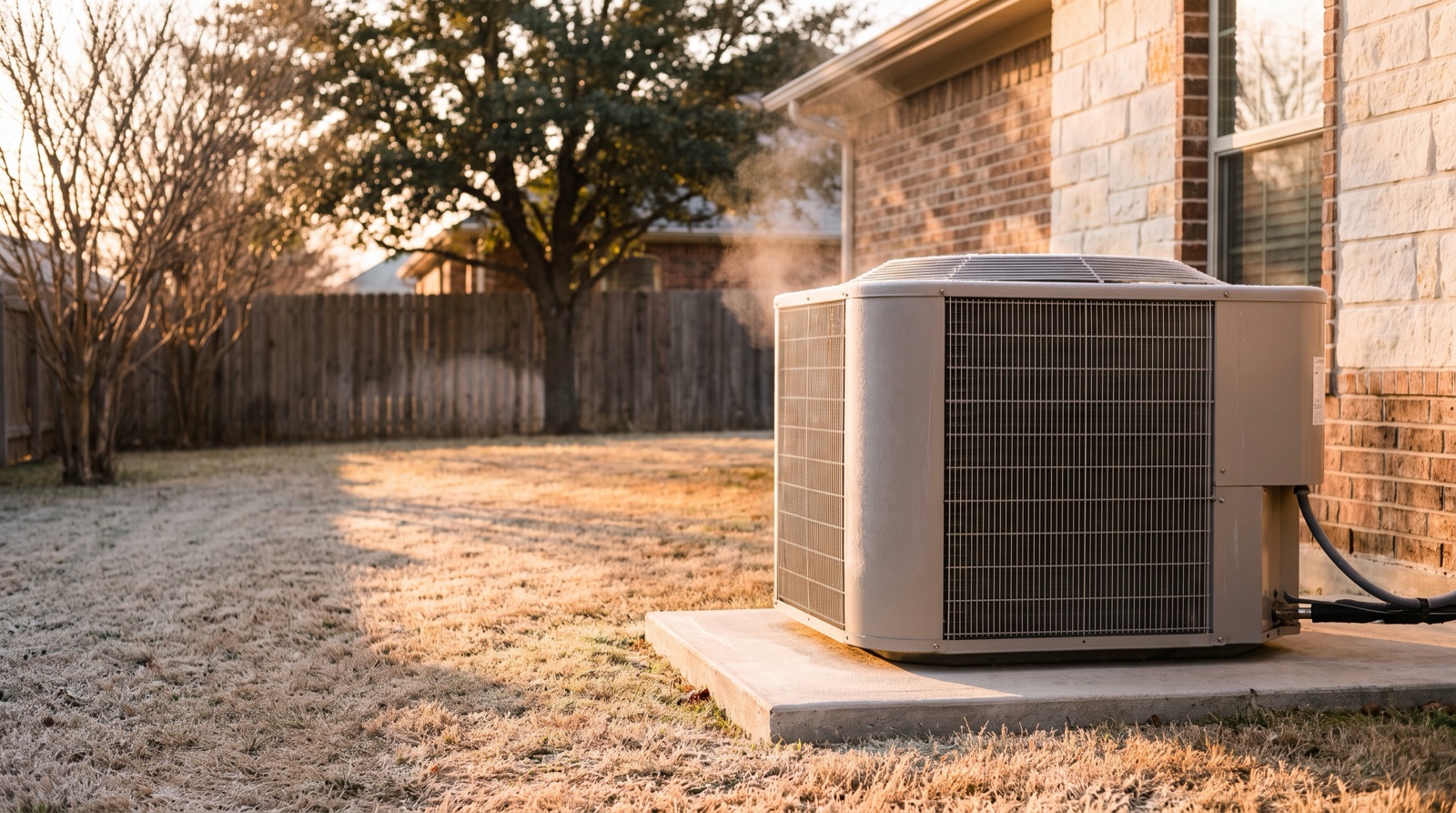
Frost on a heat pump is normal on cold, damp mornings. Lennox says the unit should defrost itself every 30 to 90 minutes, and Trane says each defrost typically lasts 3 to 5 minutes and can send up a cloud of steam. A unit encased in ice that won’t clear is a problem. Keep about 2 feet of open space around it and never chip ice or pour hot water on the coil.
Carrier advises against big overnight setbacks on a heat pump, because warming back up in the morning often kicks on electric auxiliary heat, which costs far more to run. Before a hard freeze, read our guide to heat pump emergency heat in a Texas freeze.
Freeze-week steps that are safe for any homeowner
When a hard freeze is in the forecast, any homeowner can safely hold the thermostat steady, protect exposed pipes, keep the outdoor unit clear and test carbon monoxide alarms. Anything inside the furnace cabinet, the gas line or the refrigerant circuit belongs to a licensed technician.
February 2021 showed why. The National Weather Service office for Austin and San Antonio recorded 3 to 8 inches of snow along and near I-35, and the storm brought failed power grids and burst water pipes across Texas.
- Thermostat. Keep it steady day and night. If you leave town, Texas A&M AgriLife says to set it no lower than 55°F.
- Pipes. Open sink cabinet doors so warm air reaches the plumbing, and cover outdoor faucets.
- Air filter. Swap a dirty one. ENERGY STAR warns it can raise energy costs and damage the equipment.
- Outdoor unit. Clear away leaves and mulch. Keep your hands out.
- CO alarms. CPSC recommends them on every level of the home and outside sleeping areas.
Stop there. If you smell gas, leave the house and call your gas utility from outside. Don’t open the burner compartment, chip ice off a coil or touch refrigerant lines. In Texas, heating and AC work requires a TDLR license, and Cool Kings holds license TACLB00074401E.
When to schedule heating service before the first freeze
The best time to book heating service in Central Texas is fall, before the first freeze. At Austin’s Camp Mabry station, NOAA’s 1991 to 2020 climate normals put the median first freeze on December 3, with about 12 nights a year at 32°F or colder. If your HVAC system hasn’t been checked yet, there’s still time.
ENERGY STAR recommends a fall heating check because contractors get busy once winter arrives. Here, a heating system can sit idle for months and then get called on overnight. For what a good maintenance visit should include, use our fall HVAC tune-up checklist for Central Texas.
Who to call for heating and AC services in Buda
For heating and AC service in Buda, TX, call a TDLR-licensed HVAC contractor that’s based nearby, offers same-day appointments during business hours and will show you repair and replacement costs side by side. A local base matters most during a cold snap, when every company’s schedule fills up at once.
Check the license on the TDLR website, then ask how soon they can come out and whether the tech will explain your options before starting work.
Cool Kings is one of those local options. Terry and Corey Lutrick, a father-son team, started the company in Buda in 2015, and Terry brings more than 30 years in the trade. As a York factory authorized dealer, we can also quote a replacement when repair no longer makes sense. Learn more about our heating and AC service in Buda, including heating repair and maintenance services.
Winter HVAC questions we hear in Buda
Is 72 a good temperature for heat in the winter?
72°F is comfortable, but every degree lower saves energy. With a heat pump, make changes gradually, since big jumps can bring on costly auxiliary heat (Carrier). If you’ll be away during a freeze, Texas A&M AgriLife says not to set it below 55°F.
What maintenance should I do on my furnace before winter?
Change the air filter, test the thermostat in heat mode and clear stored items away from the furnace and water heater. Test your carbon monoxide alarms. For a gas furnace, CPSC recommends a yearly professional inspection of the furnace, flue and vents.
When does the first freeze usually hit Buda?
Austin’s Camp Mabry weather station is a good reference. NOAA’s 1991 to 2020 normals put the median first freeze there on December 3 and the median last freeze on February 20, with about 12 freezing nights a year. Most winters stay mild, but February 2021 showed how hard a freeze can hit.
Should I cover my heat pump for winter?
No. A heat pump runs all winter and needs open airflow, and Lennox recommends keeping about 2 feet clear on all sides. You can gently brush light snow off the top, but never chip ice or pour hot water on the unit. If ice keeps coming back, call for service.
Do newer homes in Buda subdivisions need winter HVAC prep?
Yes, just a different kind. Newer homes often have the furnace or air handler in the attic, where condensate lines can freeze below 32°F, and many use heat pumps. Make sure attic lines are insulated, keep the outdoor unit clear and avoid big thermostat swings.
If your heat isn’t keeping up or your heat pump is icing over, call us at (512) 318-7212. We offer same-day service during business hours, and you’ll work with a father-son team, Terry and Corey Lutrick, who know Central Texas winters well. Reach out to Cool Kings Heating & Air in Buda to request service.
Get a Quote
From Our Blog